


Introduction: The Yellow River winds far beyond the drifting white clouds; a solitary city stands amidst towering mountains.
The factors influencing the transition of a fluidized bed granulation process from pilot-scale development to large-scale production comprise three aspects: formulation, process, and equipment. This study conducts an in-depth analysis of the relevant factors associated with formulation, process, and equipment to identify key parameters requiring focused attention. In the formulation phase, the parameters remain consistent with those used during the pilot-scale development stage; in the process phase, the critical parameters include binder flow rate; in the equipment phase, the critical parameters include equipment load capacity, rotating disc speed, and equipment geometry. By integrating pilot-scale development data, practical experience, and theoretical knowledge, the impact of these parameters on large-scale production is mitigated.
This study aims to leverage comprehensive pilot-scale development data, combined with practical experience and theoretical knowledge, to establish a bridge from pilot-scale development to scale-up production for fluidized-bed granulation processes, thereby formulating scientifically sound and effective scale-up strategies for such processes.
1. Pilot-scale formulation process testing
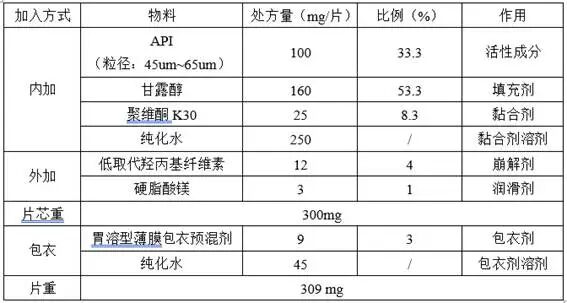
(1) Prescription
(2) Process
The specific processes include:
① Fluidized bed granulation: Place the API and mannitol (passed through a 60-mesh sieve) in a fluidized bed, set the inlet air temperature to 55 °C, and adjust the air flow rate to achieve an optimal fluidization state of the powder material (fluidization time: 10 min). When the material temperature rises to 35–45 °C and the fluidization time is reached, begin spraying the binder solution (binder flow rate: 30 rpm; atomization pressure: 0.30 MPa). Subsequently, dry the prepared granules in the fluidized bed, controlling the moisture content of the granules below 1.5 %, and discharge the material once its temperature drops below 35 °C. Finally, pass the discharged granules through a 24-mesh sieve for size adjustment.
②: The sieved material was manually mixed with magnesium stearate (60-mesh) in a 1:1 ratio for 1 min, then uniformly mixed with low-substituted hydroxypropyl cellulose (60-mesh) under stirring at 50 r/min for 10 min;
③: Tablet compression: theoretical tablet weight 300 mg, weight variation ±4.5%, target hardness: 100 N (80 N–120 N);
④: Coating: Target weight increase: 3% (2.5%–3.5%);
2. Scale up the production recipe
Maintain consistency with the formulation used in the pilot development phase.
3. Expanded Analysis of Production Process Factors
(1) Adhesive flow rate
Granule formation is primarily governed by the combined effects of the binder flow rate, atomization pressure, inlet air temperature, and inlet air flow rate. When the atomization pressure, inlet air temperature, and inlet air flow rate remain constant, an excessively high binder flow rate results in oversized binder solution droplets, high moisture content in the resulting powder particles, and large particle sizes, which can lead to bed collapse and other operational failures, ultimately causing granulation failure. Conversely, an excessively low binder flow rate produces excessively small binder droplets, which may induce spray drying phenomena; this condition, characterized by low particle moisture content, small particle sizes, and a higher proportion of fine powder, can also lead to granulation failure.
During the preliminary development phase, the adhesive flow rate was set at 30 rpm, and the volume of adhesive per unit time was calculated.
During the production phase, the adhesive flow rate can be calculated using the following formula:
S2=S1*(V2/V1)
S1: Bonding agent flow rate during the pilot development phase;
S2: Increase the adhesive flow rate during the production phase;
V1: Air volume of equipment during the pilot development phase;
V2: Increase the air volume of equipment in the production phase;
During the scaled-up production phase, increase the binder flow rate to the calculated value, adjust the atomization pressure, and maintain the spray droplet size consistent with that established during the pilot-scale development phase.
(2) Tablet hardness range
Hardness is a critical quality attribute of tablets. If a tablet has insufficient hardness, it may easily lead to phenomena such as tablet loosening and excessive dissolution, which can severely compromise subsequent processes—including coating, packaging, storage, and transportation—resulting in poor fitting of the dissolution curve and adversely affecting the BE pass rate. Conversely, if a tablet has excessive hardness, it may experience difficulty in disintegration and excessively slow dissolution, similarly leading to poor fitting of the dissolution curve and adversely affecting the BE pass rate.
During the preliminary development phase, the target hardness was set at 100 N; tests were also conducted at 80 N and 120 N, all of which complied with the quality standards.
During the production phase, based on the precision of the tablet press, the target hardness is set at 100 N (90 N–110 N).
(3) Coating weight increase range
The coating weight increase affects the disintegration and dissolution behavior of tablets. If the coating weight increase is too small, it may lead to excessive disintegration and rapid dissolution, resulting in poor fitting of the dissolution curve and adversely affecting the BE pass rate. Conversely, if the coating weight increase is too large, it may cause excessive slow disintegration and dissolution, similarly leading to poor fitting of the dissolution curve and adversely affecting the BE pass rate.
During the pilot development phase, the target weight gain was set at 3%; weight gains of 2.5% and 3.5% were also evaluated, both of which met the quality standards.
In the production phase, the target weight gain is 3% (2.5%–3.5%).
4. Analysis of Production Equipment Factors
(1) Equipment load capacity
After loading material into the fluidized bed, the process involves stages such as mixing, fluidized bed granulation, and drying. An appropriate loading quantity (by volume) facilitates efficient material mixing and the successful completion of subsequent fluidized bed granulation and drying operations. While fluidized bed manufacturers typically recommend a loading range of 30%–70% (by volume), in practical research, development, and production settings, it is advisable to control this range between 40%–60% (by volume), taking into account the effect of liquid addition on the material's volume. If significant changes in material volume are anticipated, the loading quantity should be appropriately adjusted.
Smin=V*0.4*BD
Smax= V*0.6*BD
S: batch,kg;
V: operating volume of the fluidized bed expansion chamber, L;
BD: Bulk density of the finished granules, g/ml;
During the pilot development phase, the loading capacity shall be controlled between 40% and 60% (by volume).
During the production ramp-up phase, maintain the loading capacity between 40% and 60% (by volume).
(2) Geometric configuration of the fluidized bed
Different geometric configurations of fluidized beds significantly influence the mixing uniformity of materials, as well as the performance of fluidized bed granulation and drying processes. In practical research, development, and production operations, it is advisable to select equipment from the same manufacturer—either different models or those with identical geometric configurations—to conduct pilot-scale studies, thereby mitigating the risks associated with subsequent scale-up production.
In the scale-up phase, it is preferable to select a fluidized bed from the same manufacturer and with the same geometric configuration as that used in the pilot-scale R&D phase, albeit with a different load capacity.
(3) Rotating disk speed
A common method for increasing the rotational speed of a turntable is to keep the radial speed of the turntable constant as its diameter increases.
N2=N1*(d1/d2)
N1: Rotational speed of the turntable during the pilot development phase, in r/min;
N2: Increase the rotary table speed during the production phase, in r/min;
d1: Diameter of the turntable during the pilot development phase, m;
d2: Increase the diameter of the rotary table during the production phase, m;
5. Scale up production
(1) Prescription and Process
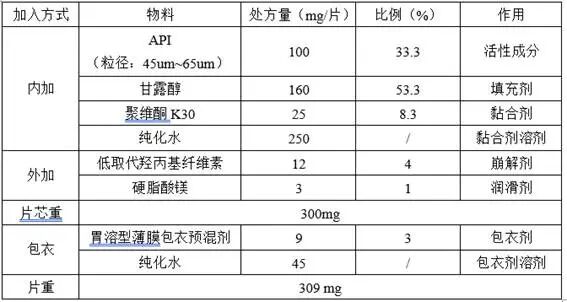
The specific processes include:
① Fluidized bed granulation: Place the API and mannitol (passed through a 60-mesh sieve) in a fluidized bed, set the air inlet temperature to 55 °C, and adjust the air flow rate to achieve an optimal fluidization state of the powder material (fluidization time: 10 min). When the material temperature rises to 35–45 °C and the fluidization time is reached, begin spraying the binder solution (the droplet size of the binder atomization solution matches that used in the pilot-scale development stage; increase the binder flow rate to the calculated value). Subsequently, dry the prepared granules in the fluidized bed, controlling the moisture content of the granules below 1.5 %, and discharge the material once its temperature drops below 35 °C. Finally, pass the discharged material through a 24-mesh sieve for size adjustment.
②: The sieved material was manually mixed with magnesium stearate (60-mesh) in a 1:1 ratio for 1 min, then uniformly mixed with low-substituted hydroxypropyl cellulose (60-mesh) under stirring at 50 r/min for 10 min;
③: Tablet compression: theoretical tablet weight 300 mg, weight variation ±4.5%, target hardness: 100 N (90 N–110 N);
④: Coating: Target weight increase: 3% (2.5%–3.5%);
(2) Key considerations during the scale-up phase
①: Particle size distribution and bulk density
The particle size distribution and bulk density of the granulated material remain essentially consistent with those observed during the pilot-scale development phase.
(3) Dissolution data

(4) The finalized prescription and manufacturing process
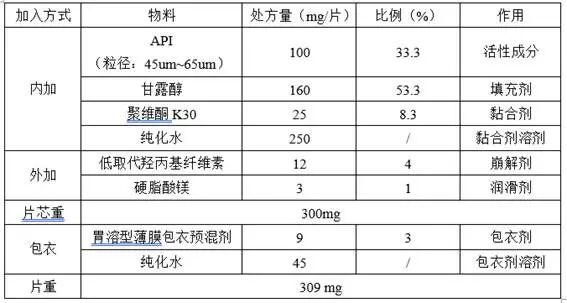
The specific processes include:
① Fluidized bed granulation: Place the API and mannitol (passed through a 60-mesh sieve) in a fluidized bed, set the air inlet temperature to 55 °C, and adjust the air flow rate to achieve an optimal fluidization state of the powder material (fluidization time: 10 min). When the material temperature rises to 35–45 °C and the fluidization time is reached, begin spraying the binder solution (the droplet size of the binder atomization solution matches that used in the pilot-scale development stage; increase the binder flow rate to the calculated value). Subsequently, dry the prepared granules in the fluidized bed, controlling the moisture content of the granules below 1.5 %, and discharge the material once its temperature drops below 35 °C. Finally, pass the discharged material through a 24-mesh sieve for size adjustment.
②: The sieved material was manually mixed with magnesium stearate (60-mesh) in a 1:1 ratio for 1 min, then uniformly mixed with low-substituted hydroxypropyl cellulose (60-mesh) under stirring at 50 r/min for 10 min;
③: Tablet compression: theoretical tablet weight 300 mg, weight variation ±4.5%, target hardness: 100 N (90 N–110 N);
④: Coating: Target weight increase: 3% (2.5%–3.5%);
6. Conclusion: Why should the Qiang flute lament the willows? The spring breeze does not reach the Yumen Pass.
During the pilot-scale development phase, the hardness range of the tablets and the coating weight gain range are evaluated to mitigate corresponding risks in the scale-up production process. Based on practical experience and theoretical knowledge, key parameters for the scale-up phase—such as binder flow rate, equipment load capacity, rotary disk speed, and equipment geometry—are determined. Furthermore, the granulation performance is further validated by analyzing particle size distribution and bulk density.
Drawing on practical R&D and production experience, and utilizing comprehensive pilot-scale R&D data, this study leverages both practical expertise and theoretical knowledge to establish a bridge from pilot-scale development to industrial-scale production for fluidized-bed granulation processes. Consequently, this work develops scientifically sound and effective scaling-up strategies for fluidized-bed granulation processes, providing actionable insights for their industrial implementation.
7. References
1. "Guiding Principles for the Determination and Comparison of Dissolution Profiles of Ordinary Oral Solid Dosage Forms" issued by the China Food and Drug Administration (March 2016).
2. "Technical Guidelines for Dissolution Testing of Ordinary Oral Solid Dosage Forms" issued by the China Food and Drug Administration (February 2015).
3. Q&A on Dissolution Curve Studies under the "Technical Guidelines for Research on Pharmaceutical Changes of Marketed Chemical Drugs (Provisional)" issued by the China Food and Drug Administration (November 2022).
4. *Development of Solid Oral Preparations: Pharmaceutical Theory and Practice*, authored by Qiu Yihong, Chen Yisheng, Zhang Guangzhong, et al.
Disclaimer: This article is intended solely for the purpose of knowledge exchange, sharing, and popular science education; it does not constitute commercial promotion, nor should it be regarded as medical guidance or medication advice. If you encounter any infringement, please contact us for removal.
Recommended Products from Our Company:
1.5055-39-0 https://www.bicbiotech.com/product_detail.php?id=6562
2.75513-72-3 https://www.bicbiotech.com/product_detail.php?id=6563
3.1346746-81-3 https://www.bicbiotech.com/product_detail.php?id=6564
4.337909-10-1 https://www.bicbiotech.com/product_detail.php?id=6565
5.1418033-25-6 https://www.bicbiotech.com/product_detail.php?id=6566

