


01
Introduction
Enhancing the specificity, safety, and efficacy of pharmaceutical agents while minimizing their toxicity represents a central objective in the development of novel therapeutic drugs. Oligonucleotides—novel therapeutic agents capable of modulating a wide range of biological functions—are undergoing rapid development. Oligonucleotides regulate gene expression through mechanisms such as silencing, activation, modulation, editing, and replacement, with particular emphasis on mRNA-based gene expression regulation. Oligonucleotides are characterized by their ease of synthesis, high specificity, broad target range, and low toxicity, making them promising candidates for the treatment of genetic disorders and neurodegenerative diseases. Despite significant advances in improving the safety and efficacy of oligonucleotides, delivering them to sites outside the liver remains challenging. Furthermore, enhancing the uptake efficiency of oligonucleotides via cellular internalization is currently a major focus of research.
Antibody–oligonucleotide conjugate drugs (AOCs) represent a novel class of therapeutic agents composed of an antibody, a linker, and an oligonucleotide. AOCs combine the antigen-specific binding capability of antibodies with the gene-regulatory function of oligonucleotides, aiming to enable targeted and highly effective therapeutic interventions for a wide range of diseases. Although AOCs are still in the early stages of development, they have seen steady progress over the past several decades. This article provides a comprehensive overview of AOC-based therapeutic agents, covering their mechanisms of action, structural components, and manufacturing processes. Additionally, it discusses current quality control strategies, existing limitations, and potential future research directions to support the advancement of AOC-based therapies.
02
I. AOC's Development History
In 1913, Nobel laureate and German scientist Paul Ehrlich first proposed the concept of the "magic bullet" —namely, the idea that toxic substances (the "warhead") could be loaded onto a carrier capable of precisely targeting cancer cells, thereby selectively eliminating malignant cells without harming healthy ones. The approval of the first antibody-drug conjugate (ADC), Mylotarg, in 2000, significantly advanced the pharmaceutical development industry. The emergence of antibody-modified drugs such as ADCs has expanded the paradigm for new drug development. ADCs have now become promising targeted therapeutic agents.
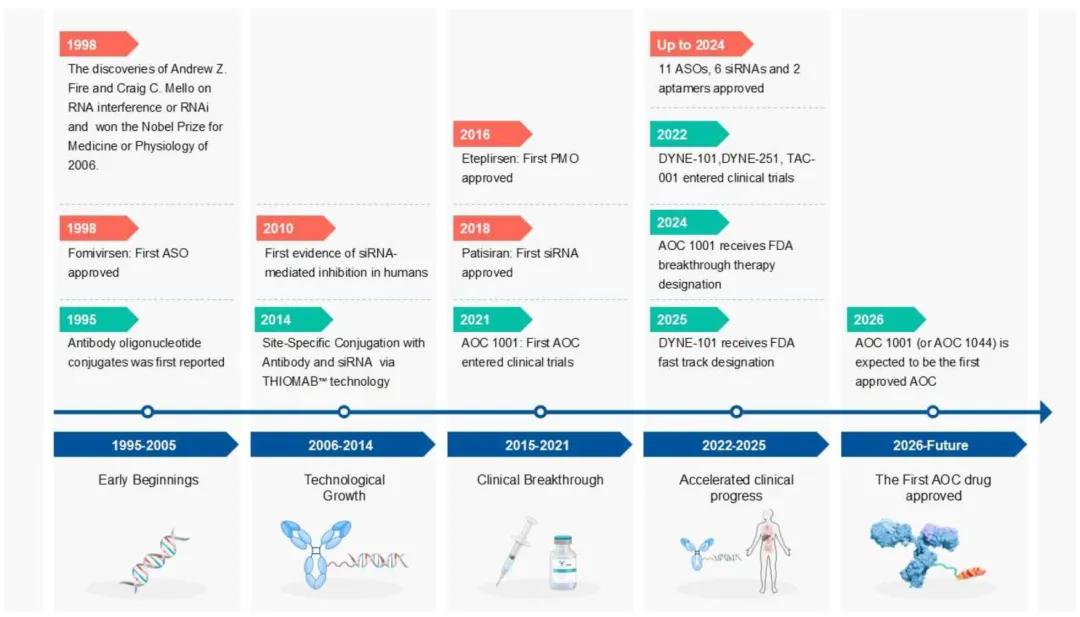
The development of AOCs is closely intertwined with the advancement of RNA interference (RNAi) therapies; over the past three decades, both fields have witnessed significant progress. We have divided the development trajectory of AOCs into five distinct phases. The early exploration phase spanned from 1995 to 2005. The first study on AOCs was published in 1995. In 1998, Fire and Mello elucidated the mechanism of RNAi, laying the foundation for siRNA-based therapeutic agents—a discovery that earned them the Nobel Prize in Physiology or Medicine in 2006. In the same year (1998), the first ASO-based drug, famciclovir, was approved for marketing. Although famciclovir has since been withdrawn from the US and European markets, its approval represented a pioneering milestone in the development of nucleic acid-based therapeutic agents.
The second phase represents the development stage of AOC technology, spanning from 2006 to 2014. In 2010, the suppression of protein expression by siRNA was first demonstrated in humans, providing a theoretical foundation for the development of siRNA-based therapeutic agents. In 2014, Genentech utilized the THIOMAB™ technology to achieve site-specific conjugation of siRNA to antibodies, laying the groundwork for the development of AOCs. From 2015 to 2021, AOCs entered a phase of clinical breakthroughs. In 2016, the first phosphorodiamidyl morpholinyl oligomer (PMO)–based therapeutic agent, etilin, received regulatory approval, expanding the field of RNAi-based therapies and providing an important oligonucleotide formulation for AOC development. In 2018, the first siRNA-based therapeutic agent, patisiran, was approved for clinical use. In 2021, the first AOC-based therapeutic agent, AOC 1001, entered clinical trials.
Since 2022, AOCs have entered an accelerated phase of clinical development. As of 2024,11 ASO-based therapies, 6 siRNA-based therapies, and 2 aptamer-based therapies have been approved for clinical use. In 2022, several AOC candidate drugs – including DYNE-101, DYNE-251, and TAC-001 – were enrolled in clinical trials. In 2024, AOC 1001 was designated as a Breakthrough Therapy by the U.S. Food and Drug Administration (FDA). In 2025, DYNE-101 received Fast Track designation from the FDA. The first AOC-based therapeutic agent, AOC 1001 (or AOC 1044), is expected to be launched in 2026.
As an emerging therapeutic approach, AOCs are experiencing significant research and development momentum worldwide. As of March 2025,31 global AOC projects are at various stages of development—ranging from preclinical studies to Phase III clinical trials—primarily targeting rare diseases, cancer, and neurodegenerative disorders. For example, Delpacibart Etedesiran (AOC 1001), developed by Avidity Biosciences, has entered Phase III clinical trials for the treatment of Duchenne muscular dystrophy type 1. This RNAi-based therapeutic agent incorporates an anti-transferrin receptor 1 (TfR1) antibody that enables targeted delivery of oligonucleotides. Other AOCs developed by Avidity Biosciences—namely Delpacibart Braxlosiran (AOC 1020) for faciocapsulohromial muscular dystrophy and Delpacibart Zotadirsen (AOC 1044) for Duchenne muscular dystrophy—are currently undergoing Phase II clinical trials. The development of these therapies underscores the technical advantages of AOCs in the treatment of muscular degenerative diseases.
TAC-001, developed by Tallac Therapeutics for the treatment of solid tumors, is currently undergoing Phase I/II clinical trials. TAC-001 targets the CD22 antigen and combines with a TLR9 agonist to enhance the immune response. DYNE-101, designed by Dyne Therapeutics, is intended for the treatment of Type 1 Duchenne muscular dystrophy. DYNE-101 consists of an ASO conjugated to a Fab fragment of an anti-TfR1 antibody, enabling muscle-specific delivery. DYNE-251, also developed by Dyne Therapeutics, comprises a PMO conjugated to a Fab fragment targeting TfR1. DYNE-251 is designed to facilitate targeted delivery to muscle tissue and promote exon skipping within the nucleus, thereby producing truncated yet functionally intact dystrophin in muscle cells. This therapy is indicated for patients with Duchenne muscular dystrophy who are suitable candidates for exon 51 skipping. Both DYNE-101 and DYNE-251 are currently in Phase I/II clinical trials. ABX1100, developed by Aro Biotherapeutics, is a novel Centyrin-siRNA conjugate that utilizes a small, stable protein scaffold derived from human tenascin C to target TfR1, enabling the direct delivery of a specific siRNA payload against glycogen synthase kinase-1 (GYS1) to muscle tissue for the treatment of late-onset Pompe disease. ABX1100 is currently in Phase I clinical trials.
03
II. AOC Mechanism of Action
1. Targeted delivery via antibodies
Multiple antigen targets have been identified, including transferrin receptor (TfR), lectins, receptor tyrosine kinases, integrins, and HER2/EGFR. These targets facilitate the delivery of therapeutic agents to muscle, the central nervous system, the liver, and tumor cells. TfR1 is the most frequently targeted antigen among investigational AOCs. TfR1 is expressed at low levels in most normal cells but is significantly upregulated in cells with high proliferative activity (e.g., basal cells) or high iron requirements (e.g., erythroid progenitor cells). Numerous genes associated with cancer pathogenesis regulate TfR1 expression. TfR1 has been investigated in the context of skeletal muscle therapy as well as in the treatment of rare diseases, oncology, and Parkinson's disease. Following recognition of the TfR1 target by antibodies, the transmembrane delivery of oligonucleotides occurs primarily through receptor-mediated endocytosis.
The mechanism by which AOCs exert their intracellular effects begins with the precise interaction between the antibody moiety and its homologous antigen on the cell surface. This high-affinity binding event serves as the initiating signal for cellular internalization, which is primarily mediated by receptor-dependent endocytosis. Upon antigen recognition, the AOC–antigen complex induces localized invagination of the plasma membrane, leading to the encapsulation of the conjugate within a vesicular structure known as an endosome. As the newly formed endosome progresses along the endocytic pathway, it undergoes a maturation process characterized by a gradual acidification of its lumenal environment—ranging from the near-neutral pH found in early endosomes to the increasingly acidic conditions present in late endosomes and lysosomes. This maturation process is accompanied by the recruitment of various endosomal sorting complexes and hydrolases, which collectively regulate the intravesicular environment. Crucially, these intrinsic physicochemical properties—such as the pH gradient and enzymatic activity—trigger the cleavage of the linker connecting the oligonucleotide and the antibody. The linkers in AOCs are typically designed to respond to these signals, incorporating elements such as acid-labile bonds or protease-sensitive peptides. Following linker dissociation, the released oligonucleotides must traverse the endosomal membrane into the cytoplasmic compartment—a step commonly referred to as endosomal escape. This escape mechanism is essential for therapeutic success, as retention within the endosome can lead to lysosomal degradation and loss of enzymatic activity. Various strategies have been employed to facilitate this process, including the incorporation of fusion peptides or proton sponge polymers, or the disruption of endosomal integrity through osmotic swelling or membrane perturbation. Once released into the cytoplasm, the oligonucleotides bind to their molecular targets to modulate gene expression. Depending on the type of oligonucleotide (e.g., antisense oligonucleotides (ASOs), small interfering RNAs (siRNAs), or splicing regulators), it may hybridize with a complementary mRNA sequence, thereby engaging endogenous mechanisms—such as RNase H for transcript cleavage, the RNA-induced silencing complex (RISC) for post-transcriptional silencing, or alterations in splicing patterns to generate functional protein subtypes. This gene regulatory effect ultimately gives rise to phenotypic changes, such as reduced expression of pathogenic proteins in genetic disorders or enhanced immune responses in oncological applications.
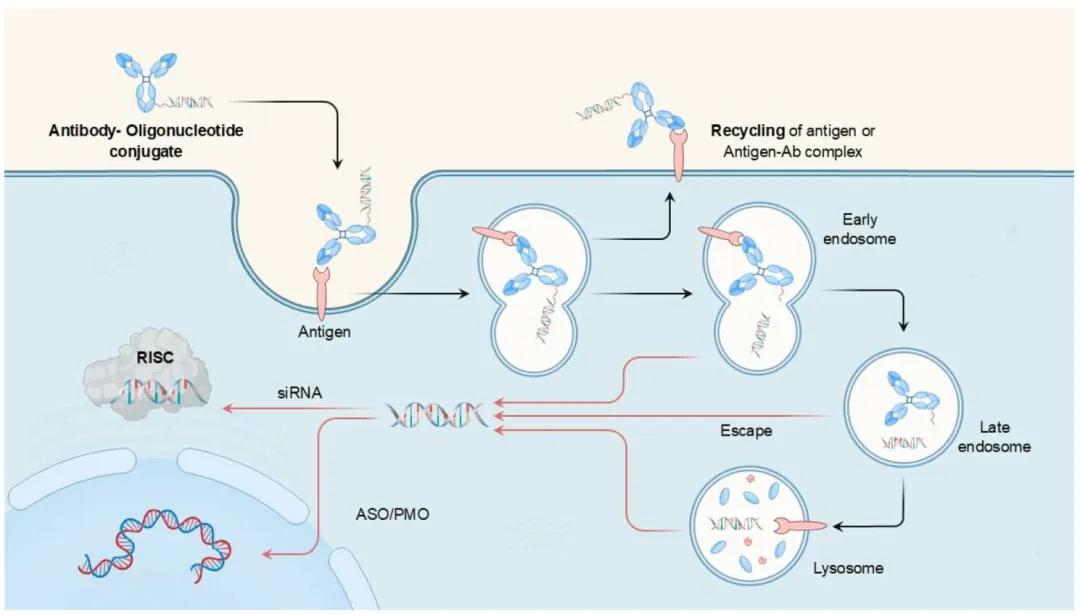
Although most AOCs targeting different antigens share an intrinsic internalization mechanism involving clathrin-mediated endocytosis, their internalization rates and post-endocytic trafficking pathways differ. AOCs targeting TfR1 undergo rapid internalization in mouse skeletal muscle; following a single 10 mg/kg injection, over 80% of the target gene expression was suppressed within 24 hours. In contrast, AOCs targeting TENB2 are internalized solely near the tumor vasculature, resulting in only 33% gene suppression within three days. TfR1 is a circulating antigen; upon internalization, it returns the AOCs to the cell surface, whereas HER2 is a degradation antigen that directs the AOCs toward lysosomes for degradation.
The inefficient escape of oligonucleotides from the endosomes represents a significant technological bottleneck. The endosomal membrane possesses a lipid bilayer capable of isolating and retaining approximately 99% of RNA-based therapeutic agents. Researchers at the University of Hong Kong employed quantitative NanoSIMS microscopy to demonstrate that only 1%–2% of GalNAc-ASO conjugates escape from hepatocyte endosomes in vivo. Furthermore, the inherent hydrophilicity and negative charge of RNA molecules hinder their translocation across the charged cell membrane.
2. Oligonucleotides as pharmaceutical agents
Traditional ADCs deliver cytotoxic payloads targeting specific intracellular molecular sites to disrupt critical cellular mechanisms. In contrast, oligonucleotide payloads in AOCs act on upstream signaling molecules—such as endogenous mRNAs—by specifically silencing target mRNAs through complementary base pairing, thereby reducing the production of pathogenic proteins. Several distinct mechanisms have been clinically validated, including intron splicing modulation (e.g., the ASO-based drug nusinersen for the treatment of spinal muscular atrophy) and the formation of RNA-induced silencing complexes (e.g., the siRNA–lipid nanoparticle-based drug patisiran for the treatment of transthyretin amyloidosis).
Challenges associated with the preparation of ADCs include heterogeneity, linker hydrophobicity, aggregation, and linker stability. The size of the drug molecule as well as its contribution to the overall charge of the final conjugate also significantly influence ADC preparation. AOCs share structural similarities and design principles with ADCs; however, the conjugation of oligonucleotides may present greater challenges. For example, in ADCs, the molecular weight of the drug–linker moiety is typically less than 2 kDa, whereas that of oligonucleotides often exceeds 10 kDa. Consequently, the impact of oligonucleotides on the physicochemical properties of the antibody is more pronounced than that of small-molecule drugs. Additionally, the negatively charged phosphate backbone of oligonucleotides confers water solubility and alters the overall charge of the antibody during conjugation. These negatively charged oligonucleotides impart a distinct charge distribution to AOCs compared to ADCs; therefore, specialized analytical and characterization methods are required, rather than techniques designed for direct use in ADCs.
04
III. Structural Components of AOC Therapeutic Agents
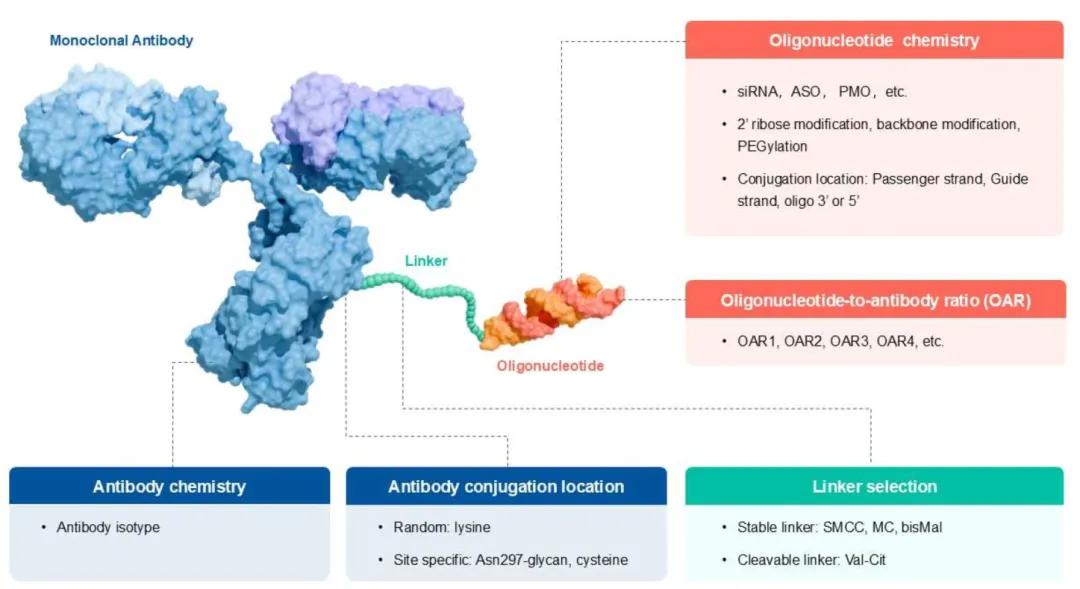
AOCs consist of antibodies or antibody fragments, linkers, and oligonucleotides. The antibodies are internalized by the target cells. The linkers remain stable in the systemic circulation to prevent or minimize the degradation of the payload before it reaches the target tissue. The linkers also facilitate the rapid release of the oligonucleotides following cellular uptake. The oligonucleotides exert their therapeutic effect by regulating intracellular target mRNA. Therefore, AOCs represent conjugates of biomacromolecules (antibodies) and chemical macromolecules (oligonucleotides), possessing unique mechanisms of action and pharmacokinetic profiles.
1. Antibody
Antibody-based components guide AOCs. By combining the targeting capability of antibodies with the gene-regulatory function of oligonucleotides, the therapeutic potential of oligonucleotides is expanded, enabling precise modulation of pathogenic proteins. Antibodies used in AOCs should possess the following characteristics: high specificity and affinity for the target antigen, efficient and rapid internalization, and favorable pharmacokinetic properties. Low-immunogenic monoclonal antibodies (mAbs) serve as ideal delivery vehicles for transporting oligonucleotides to extrahepatic targets and participating in various pharmacological effects—such as antibody-dependent cellular phagocytosis—thereby facilitating the extrahepatic delivery of oligonucleotides.
Antibody types: Full-length monoclonal antibodies (mAbs), particularly immunoglobulin G (IgG), are the most commonly used antibodies in AOCs. The IgG molecule has a molecular weight of approximately 150 kDa and consists of two heavy chains and two light chains, forming distinct Fab and Fc regions. IgGs exhibit high specificity, strong affinity, and an extended half-life. However, their relatively large size limits permeability, thereby reducing the infiltration of IgG-conjugated AOCs into deeper tissue regions. Full-length antibodies, including IgGs, primarily accumulate within a few cellular layers adjacent to tumor vasculature rather than in the deeper tissue regions. Despite these challenges, advances in AOC design are leveraging the advantages of full-length mAbs to overcome such limitations and enable targeted delivery. Avidity Biosciences is advancing the clinical development of Delpacibart Etedesiran, a drug that utilizes a full-length mAb targeting TfR1 for muscle-specific delivery.
Antibody fragments, such as Fab or scFv, are increasingly being used to address the issue of limited tissue penetration associated with full-length antibodies. These antibody fragments are generated either through enzymatic digestion of intact antibodies or through the production of truncated antibodies via genetic engineering. The molecular weight range of antibody fragments spans from 25 kDa to 50 kDa. These fragments retain high specificity and affinity and exhibit enhanced tissue penetration; however, their half-life is shorter than that of full-length antibodies. Sutherland et al. demonstrated that antibody fragments targeting carcinoembryonic antigen (CEA) exhibited significantly improved penetration compared to intact IgG in an in vitro tumor spheroid model. Dyne Therapeutics is advancing the clinical development of DYNE-101, a drug that utilizes a Fab fragment targeting TFR1 for muscle-specific delivery.
VHH antibodies (nanobodies), derived from camelid species, consist of a single variable domain with a molecular weight ranging from 12 kDa to 15 kDa. Compared to full-length monoclonal antibodies (mAbs) and fragmented antibodies, VHH antibodies exhibit higher specificity and affinity, as well as superior tissue penetration, albeit with a shorter half-life. Nanobodies achieve high tumor-to-background contrast within 3–5 hours after administration, indicating their rapid penetration into deep tissue regions. AOC strategies utilizing VHH antibodies are emerging as a promising area of research; to date, no relevant investigational drugs have advanced to clinical trials.
Antibody specificity and affinity: The unique molecular structure of an ideal antibody forms the basis for its high specificity and appropriate affinity toward its antigen target. Y-shaped antibodies contain two variable regions, which consist of complementarity-determining regions (CDRs) that acquire diversity through V(D)J recombination. The distinctive conformation of these CDRs ensures precise matching with the target antigen, which is the foundation for high specificity and affinity. Precise targeting minimizes the non-specific uptake of off-target cells, thereby reducing the toxicity of AOCs and enhancing their therapeutic efficacy. Appropriate affinity also increases the likelihood of AOCs being internalized by target cells, thereby improving overall efficiency.
Pharmacokinetic properties: The conjugation of antibodies with oligonucleotides induces physicochemical changes compared to native antibodies. These alterations may influence pharmacokinetics and should be carefully considered during the AOC development process. Humanized antibodies exhibit pharmacokinetic profiles similar to those of non-conjugated antibodies and are increasingly being utilized in the design of next-generation ADCs. Humanized antibodies provide valuable guidance for AOC design; their low immunogenicity and optimal pharmacokinetic properties are crucial for antibody selection.
2.oligonucleotides
Oligonucleotides encompass short, low-molecular-weight RNA or DNA molecules as well as their synthetic analogs (heterologous nucleic acids). They find diverse applications in therapy, diagnostics, and immunomodulation, including pathogen detection, gene silencing, and gene expression regulation. Oligonucleotides are a key component of AOCs and underlie their pharmacological effects. This class includes ASOs, small interfering RNAs (siRNAs), PMOs, microRNAs (miRNAs), and nucleic acid aptamers. Among these, ASOs, siRNAs, and PMOs have been the most extensively studied. Unlike traditional ADC small-molecule payloads that target molecular targets to induce the desired phenotype, current synthetic oligonucleotide-based therapeutic agents target upstream signaling molecules—such as endogenous mRNAs. Oligonucleotides specifically silence target mRNAs through complementary base pairing, thereby reducing the production of pathogenic proteins.
ASOs: ASOs are single-stranded nucleic acid molecules used for therapeutic purposes to regulate gene expression by targeting mRNA or pre-mRNA through base complementarity. The antibody-targeted delivery approach employed in AOCs can significantly enhance the efficacy and safety of conventional ASO-based therapies. The primary mechanisms of action of AOCs include specific binding to target RNA, induction of RNase H-mediated RNA degradation, or inhibition of RNA splicing and translation through steric hindrance, thereby modulating the expression of specific genes. For example, the ASO-based drug Spinraza (Nusinersen), used in the treatment of spinal muscular atrophy, increases the production of SMN protein by modulating the expression of the SMN2 gene. Spinraza has demonstrated sustained therapeutic benefit in clinical trials conducted in patients with spinal muscular atrophy. For AOCs, the first reported AOC utilized ASOs as the nucleic acid moiety; in recent years, several AOCs have entered clinical trials and employ ASOs – a notable example being DYNE-101.
Small interfering RNAs (siRNAs): siRNAs are the most extensively studied and widely used oligonucleotides in clinical practice. Double-stranded siRNAs typically consist of 21–23 base pairs. The antisense strand is fully complementary to the target mRNA, and the siRNA-mediated degradation of the target mRNA is facilitated by the RNA-induced silencing complex (RISC), thereby silencing the gene. Inclisiran is an approved siRNA molecule with proven efficacy and safety profile that targets the mRNA of proprotein convertase subtilisin-knottin 9 (PCSK9), leading to a sustained reduction in both this protein and low-density lipoprotein cholesterol levels. Compared to traditional small-molecule drugs, siRNAs exhibit higher specificity and a broader target spectrum, enabling precise modulation of proteins or genes that are difficult to target with small molecules. However, compared to antisense oligonucleotides (ASOs), siRNAs generally demonstrate lower tissue permeability. Numerous clinical trials involving antisense oligonucleotide-based therapies (AOCs) utilize siRNA as a payload; examples include Delpacibart Etedesiran and Delpacibart Braxlosiran, developed by Avidity.
PMOs: PMOs are synthetic single-stranded DNA analogs in which natural phosphodiester bonds are replaced by phosphodiimide bonds. The morpholine ring in each PMO subunit confers enhanced stability and resistance to enzymatic degradation. PMOs primarily regulate gene expression by complementarily binding to pre-mRNAs, thereby blocking the spliceosome's recognition of specific exons of target functional proteins. PMO binding induces exon skipping and restores the translation of functional proteins. Eteplirsen (EXONDYS 51®), approved in 2016, is a PMO-based antisense oligonucleotide used to treat patients with Duchenne muscular dystrophy (DMD) who have confirmed DMD gene mutations and are suitable candidates for exon 51 skipping therapy. Although PMOs represent the most recently introduced class of oligonucleotides in the field of antisense oligonucleotide (AOC) therapies, they play an important role in this domain. Delpacibart Zotadirsen, developed by Avidity, utilizes PMOs as the oligonucleotide component of its AOC-based therapeutic approach.
Oligonucleotide modification: As biological macromolecules, oligonucleotides face various challenges when introduced into the physiological environment; these challenges limit their therapeutic efficacy, including poor stability and susceptibility to degradation by serum nucleases. AOCs typically carry oligonucleotide payloads. Modifications targeting the oligonucleotide backbone, sugar moieties, or nucleobases include backbone remodeling, sugar ring modification, terminal capping, and 5′-phosphorylation. These modifications enhance the stability and therapeutic efficacy of oligonucleotides. Significant advances in oligonucleotide chemistry and conjugation technologies have facilitated the development of numerous oligonucleotide conjugates for use as clinical candidates.
3. Connector
The linker establishes an efficient and controllable chemical bridge between the targeted antibodies and therapeutic oligonucleotides in AOCs. The linker significantly influences key parameters of AOCs, including the oligonucleotide–antibody ratio (OAR), therapeutic index, pharmacokinetic/pharmacodynamic profile, and overall stability. Therefore, the design and selection of linkers require a comprehensive consideration of multiple factors, such as stability, controlled release, and biocompatibility.
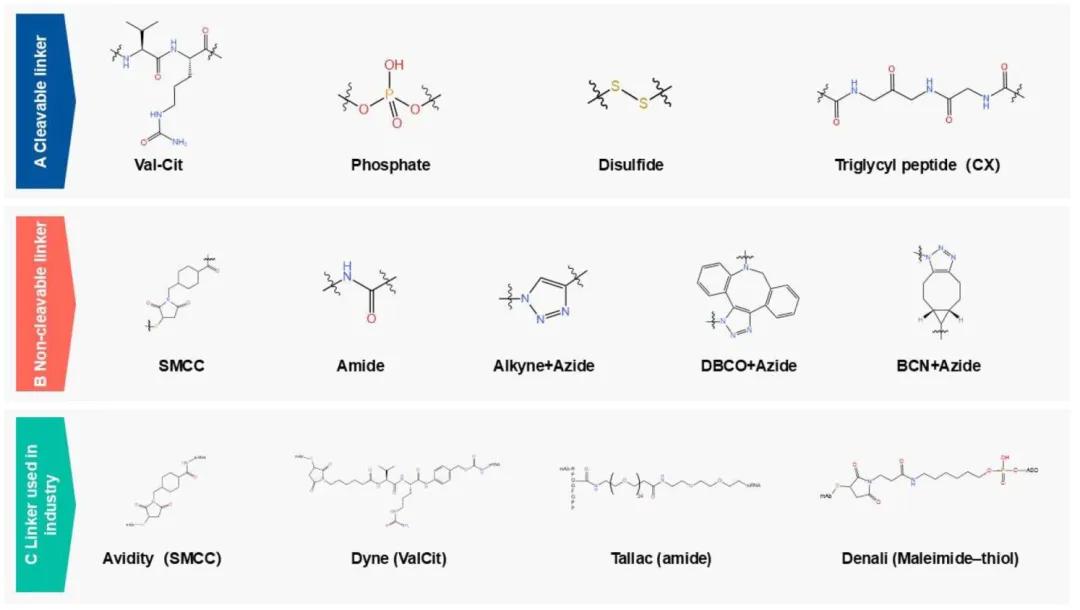
Linkers can be broadly classified into two types: cleavable and non-cleavable. Cleavable linkers release their payload under specific physiological conditions and can be further subdivided into enzyme-sensitive, acid-sensitive, and reduction-sensitive subtypes. Enzyme-sensitive linkers can be designed to take advantage of the unique microenvironment of lysosomes; for example, hydrolases such as cathepsins can cleave peptide-bonded linkers (e.g., Val-Cit), while phosphatases can degrade phosphate-ester-bonded linkers. The peptide sequence or chemical structure of the linker must strike a balance between stability in plasma and efficient cleavage within the cell. The release of oligonucleotides can also be triggered by acidic conditions (pH 5.5 in the endosome, pH 4.5 in the lysosome) or by a reducing environment. Common acid-sensitive linkers include hydrazine, acetal, and carbonate bonds. Elevated intracellular glutathione concentrations induce the selective cleavage of disulfide bonds; therefore, the stability of the linker can be fine-tuned based on the conjugation site and the degree of steric hindrance.
Non-lytic linkers enhance conjugation stability, making them suitable for therapies requiring prolonged circulation and sustained activity. Common conjugation strategies include covalent conjugation with natural amino acids (e.g., cysteine or lysine), formation of maleimide–thiol linkages (e.g., via SMCC), or site-specific conjugation using click chemistry approaches (e.g., copper-catalyzed azide–alkyne cycloaddition or strain-promoted azide–alkyne cycloaddition).
Direct conjugation: Direct conjugation is the most commonly used conjugation method in AOC design. Introducing functional groups onto oligonucleotides enables their direct attachment to antibodies. The diversity of chemical modifications facilitates the use of various linkers—including cleavable and non-cleavable linkers, as well as previously validated ADC linkers. Linkers designed for specific binding sites on antibodies can effectively modulate OARs and are generally smaller in size, resulting in a lesser impact on the overall physicochemical properties of AOCs compared to larger linkers. However, this approach requires the incorporation of linker attachment sites onto the oligonucleotides, followed by the chemical conjugation of the linkers to these sites. Consequently, the versatility of direct conjugation depends on the high stability of the linker; this linker must be compatible with DNA or RNA molecules and stable during their double-strand annealing process.
Among current ADCs, the primary conjugation groups include lysine and cysteine residues; in recent years, the use of cysteine-based conjugation has increased significantly. Similarly, AOCs currently predominantly employ cysteine residues as key conjugation groups to efficiently attach oligonucleotide payloads via their reactive thiol groups—particularly through engineered cysteine residues for site-specific conjugation—thereby enabling precise control over the OAR value and conjugation site, and facilitating targeted delivery applications to enhance therapeutic efficacy. Cochran et al. compared various linker strategies for AOCs. To this end, they employed three distinct methods for conjugating antibodies with oligonucleotides: 1) cysteine-based conjugation, 2) lysine-based conjugation, and 3) Asn297 glycosylation-based conjugation. To implement the cysteine-based approach, the antibodies were treated with TCEP to cleave interchain disulfide bonds, thereby exposing the thiol groups on the cysteine residues; subsequently, siRNA was reacted with the maleimide-containing linker MCC to form an siRNA–linker–maleimide intermediate, which was then conjugated to the antibody via a thiol–maleimide reaction. The results demonstrated that AOCs constructed using the cysteine-based conjugation strategy outperformed those generated by other methods in terms of pharmacokinetics and siRNA delivery efficiency: lysine-based conjugation led to faster plasma clearance, whereas Asn297 glycosylation conjugation, although stable, exhibited lower plasma exposure.
Click chemistry is a modern organic synthesis strategy introduced by the American chemist Barry Sharpless in 2001 and awarded the Nobel Prize in Chemistry in 2022. Due to its high efficiency, excellent selectivity, modular nature, and mild reaction conditions, click chemistry is widely employed in the construction of antibody-oligonucleotide conjugates (AOCs). A prominent example of click chemistry is the use of strain-promoted azide–alkyne cycloaddition. In this approach, the antibody is conjugated with DBCO-PEG5-NHS, while the 5'-end of the oligonucleotide is functionalized with an azide group (-N₃) via standard solid-phase synthesis. The antibody and the oligonucleotide are then rapidly coupled via the strain-promoted azide–alkyne cycloaddition between DBCO and the azide group. This modular design enabled by click chemistry facilitates the flexible exchange of different antibodies and oligonucleotides during experimental work and supports the orthogonal conjugation of antibodies with various oligonucleotides, thereby supporting the economical and scalable production of AOCs.
Affinity coupling: A typical example of affinity coupling involves utilizing the high affinity between avidin and biotin to stably conjugate siRNA to targeted antibodies. In this study, the sense siRNA strand was monobiotinylated at its 3' terminus and assembled into a conjugate with a recombinant streptavidin and an mAb targeting the human insulin receptor. Human 293 epithelial cells transfected with a luciferase reporter gene were used to monitor gene expression and characterize this construct. The AOC construct was successfully prepared; treatment with AOC reduced luciferase expression by more than 90% within 48 hours. The RNA interference effect persisted for up to 5 days but disappeared after 7 days. The inhibitory effect was detectable even at siRNA concentrations as low as 3 nM, and the degree of inhibition increased as the siRNA concentration increased (the half-maximal inhibitory concentration was approximately 30.5 ± 11.7 nM). These findings demonstrate that the avidin–biotin system serves as an efficient and stable linker for constructing AOCs.
Ion-mediated conjugation: This approach leverages the negative charge of the oligonucleotide backbone to conjugate antibodies modified with polyanionic structures via ion-mediated interactions. The most commonly used polyanionic moiety is the endogenous protein protamine. Liberman et al. were the first to describe a method for constructing antibody-oligonucleotide conjugates (AOCs) using ion-mediated conjugation. The heavy-chain Fab fragment of the mAb F105, which targets the HIV-1 envelope protein, was fused to the protamine gene to generate the fusion protein F105-P. Incubation of F105-P with siRNA yielded the AOC. Fluorescence labeling of the siRNA demonstrated that each protamine molecule stably binds approximately six siRNAs. The constructed AOCs demonstrated effective targeted gene silencing without triggering an interferon response. This study confirms the potential of ion-mediated conjugation for constructing AOCs and highlights the simplicity of this approach. The polyanionic moiety also acts as a lysosomal escape agent, inducing lysosomal permeabilization and swelling through a "proton sponge" effect, thereby increasing membrane permeability and facilitating the release of oligonucleotides into the cytoplasm.
Despite its simplicity, ion-mediated conjugation exhibits an inherent instability. The reversibility of ion bonds makes the conjugates prone to dissociation under physiological pH or salinity variations, which can lead to the premature release of oligonucleotides. Furthermore, quality control is particularly challenging due to the reliance on indirect characterization methods—such as fluorescence labeling or PCR—often resulting in significant batch-to-batch variability and making it difficult to ensure product consistency. Finally, the lack of comprehensive in vivo stability data, including ADME profiles, introduces uncertainty into the release kinetics, increasing the risk of off-target effects and reduced therapeutic efficacy. As a result, these challenges contribute to the limited use of ion-mediated conjugation in contemporary AOC research.
05
epilogue
The molecular design of AOCs represents a highly complex and sophisticated systems engineering endeavor; its core lies in leveraging the synergistic interaction among three key components—optimized antibodies, linkers, and oligonucleotides—to achieve comprehensive biological functions ranging from precise targeting to efficient gene regulation. From a mechanistic perspective, AOCs successfully combine the cell-specific delivery capability of antibodies with the intracellular gene silencing potency of oligonucleotides; however, their overall efficacy is ultimately limited by the efficiency of critical intracellular steps, such as endosomal escape. In terms of manufacturing processes—ranging from the engineered production of antibodies and solid-phase synthesis of oligonucleotides to the controlled conjugation achieved through various chemical strategies—each step presents significant challenges in ensuring product homogeneity, stability, and biological activity. Despite these complexities, a deep understanding of the structural components and molecular mechanisms underlying AOCs, coupled with increasingly mature manufacturing platforms, is collectively driving this emerging therapeutic approach from the laboratory to clinical translation. Moving forward, further innovation will focus on developing more intelligent linkers, antibodies with enhanced penetrance, and more stable oligonucleotide chemistry, thereby unlocking the full potential of AOCs in the treatment of genetic disorders, cancer, and other diseases.
References:
Advances in the pharmaceutical development of antibody-oligonucleotide conjugates.
Eur J Pharm Sci. 2025 Dec 1:215:107292.
Disclaimer: This article is intended solely for knowledge exchange, sharing, and educational purposes only; it does not constitute commercial promotion nor should it be used as medical advice or guidance on medication use. If this article involves any copyright infringement, please contact us for removal.
Recommended products from our company:
1.202805-07-0 https://www.bicbiotech.com/product_detail.php?id=6552
2.77423-14-4 https://www.bicbiotech.com/product_detail.php?id=6553
3.14727-71-0 https://www.bicbiotech.com/product_detail.php?id=6554
4.23978-09-8 https://www.bicbiotech.com/product_detail.php?id=6555
5.225797-46-6 https://www.bicbiotech.com/product_detail.php?id=6556

